-min.png)
When Weekly Therapy Isn’t Enough: Signs You May Need a Higher Level of Care


You’re doing everything right. You show up to therapy once a week. You are honest and engaged during your sessions. You do the homework and practice the skills. But despite your best efforts, your symptoms – and your daily life – don’t seem to be improving.
If you’ve found yourself wondering whether weekly therapy is enough, whether therapy just doesn’t work for you, or whether you need more support, you are not alone. And you haven’t failed. Often, the problem isn’t the patient, the provider, or even the therapeutic approach. Instead, it’s a mismatch between the severity or complexity of what your experiencing and the level of care you’re receiving.
Outpatient psychotherapy is a familiar and accessible place to begin treatment. For many individuals, however, it isn’t the final destination. Healing may require more frequent support, greater structure, and additional opportunities to practice new skills between sessions.
Meaningful recovery demands the right level of care at the right time.
Finding The Right Level of Care
If weekly outpatient therapy is no longer serving you, it may be time to consider a different level of care. This simply means receiving treatment that is more structured, more frequent, or a better match to the complexity and severity of what you’re experiencing.
Most people are already familiar with the idea of levels of care in traditional Western medicine. Primary care physicians, specialists, urgent care centers, emergency departments, and hospitals each serve a different purpose based on medical need.
You wouldn't conclude that your primary care physician had "failed" because they couldn't perform heart surgery. You would recognize that your symptoms require a different level of expertise and intensity of care. Mental health treatment works the same way. Rather than relying on a single type of treatment for every person, mental healthcare offers a continuum of care designed to match each individual's needs.
Weekly outpatient therapy is an effective treatment for many people, but it isn't the right level of support for everyone, and it isn't always sufficient to address more severe or complex mental health concerns.
The Mental Health Continuum of Care
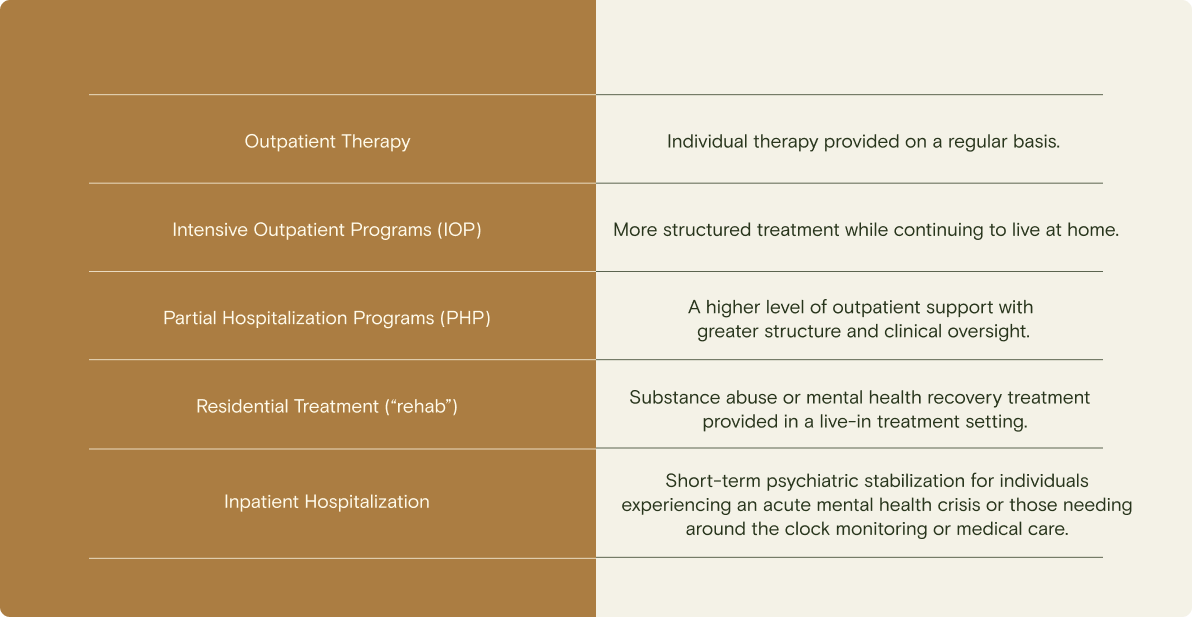
Mental healthcare includes a range of treatment options designed to match different levels of need. Depending on your symptoms, functioning, and treatment goals, your provider may recommend:
Level of Care
General Description
Outpatient Therapy
Individual therapy provided on a regular basis.
Intensive Outpatient Programs (IOP)
More structured treatment while continuing to live at home.
Partial Hospitalization Programs (PHP)
A higher level of outpatient support with greater structure and clinical oversight.
Residential Treatment (often called “rehab”)
Substance abuse or mental health recovery treatment provided in a live-in treatment setting.
Inpatient Hospitalization
Short-term psychiatric stabilization for individuals experiencing an acute mental health crisis or those needing around the clock monitoring or medical care..
Each level provides a different amount of structure, frequency, and clinical support. The appropriate level depends on a person's symptoms, functioning, safety, and treatment needs – not simply their diagnosis. Just as medications have different doses depending on the severity of symptoms, mental health treatment comes in different "doses" of support. The goal is to receive the amount of treatment most likely to help you recover.
How do you know when it’s time for more support?
For many people, the decision to pursue a higher level of care is not determined by a single symptom or diagnosis. It is based on the overall pattern of your experience, including how your symptoms affect your daily life, whether you are making meaningful progress, and whether you are receiving the support you need to meet your goals.
While each situation is unique, if several of the following feel familiar, it may be time to explore a higher level of care:
Signs You May Need a Higher Level of Care
- You're doing everything your therapist recommends, but your symptoms aren't improving.
- Progress has stagnated, slowed, or gone in reverse.
- Your symptoms are beginning to interfere with work, school, parenting, or relationships.
- You spend most therapy sessions playing catch up or managing the latest crisis instead of making meaningful progress.
- You frequently feel overwhelmed between sessions and don't have enough support when you need it most.
- You've made some progress in therapy, but continue to experience the same patterns over and over again.
- Your therapist has suggested a higher level of care, more frequent treatment, or additional support.
- You're beginning to lose hope that things can get better.
What To Do Next?
Recognizing that weekly therapy may no longer be enough is an invitation to explore whether your current treatment meets your needs, and what other treatment options exist. It does not necessitate an urgent end to your therapeutic relationship. On the contrary, a therapist with integrity can be a crucial partner in navigating next steps.
- Speak With Your Therapist. A good therapist should be open to talking honestly about what's working, what isn't, and whether additional support might be beneficial. They may have recommendations for programs, specialists, or other resources that fit your needs.
A good therapist won't be offended if you need a different level of care any more than your primary care physician would be offended if you needed to see a specialist. Recommending the right level of treatment is part of good clinical care.
- Seek a Comprehensive Assessment. If you're still unsure whether your current treatment is the right fit, consider scheduling a comprehensive assessment with a provider or treatment center with knowledge of multiple levels of care. A thorough evaluation can help clarify your diagnosis, identify factors that may be contributing to your symptoms, and determine which level of support is most appropriate. True Life Center offers prospective patients a free, confidential, biopsychosocial assessment performed by our expert clinicians. Please call True Life at 858-202-2822 to schedule an assessment, or to share your story and explore your options with a member of our team. Even if True Life isn’t the right fit, we are happy to connect you with another program or provider trusted referral.
FAQ
How do I know if outpatient therapy is enough?
Outpatient therapy is often appropriate when symptoms are manageable and you're able to function in your daily life. If symptoms are becoming more severe, frequent, or disruptive, a higher level of care may be worth exploring.
What are the signs that I may need a higher level of care?
Signs can include worsening symptoms, frequent crises, difficulty functioning at work or school, repeated hospitalizations, persistent safety concerns, or feeling "stuck" despite consistent outpatient treatment.
Does needing a higher level of care mean I've failed at therapy?
Not at all. Mental health treatment isn't one-size-fits-all. Just as a broken bone sometimes requires more than a brace, some periods of life call for more intensive support.
What's the difference between outpatient therapy, IOP, PHP, and residential treatment?
These programs differ in the amount of support and structure they provide. The appropriate level of care depends on your symptoms, safety, functioning, and treatment goals.
Can I continue seeing my current therapist if I need a higher level of care?
Sometimes. This depends on the treatment program and your therapist's recommendations. In many cases, outpatient therapy can resume after completing a higher level of care.
Will medication automatically be recommended if I need more intensive treatment?
No. Medication decisions should always be individualized. A higher level of care does not automatically mean medication is necessary.
How is the right level of care determined?
A comprehensive assessment looks at your symptoms, daily functioning, safety, medical history, support system, and treatment history to determine which level of care is most likely to help.
Can I step down to outpatient therapy after completing a higher level of care?
Yes. Many people transition back to outpatient therapy after completing an intensive program. Ongoing therapy can help maintain progress and prevent relapse.
Will insurance cover a higher level of care?
Coverage varies by insurance plan and medical necessity. Our admissions team can help you understand your benefits and discuss available options.
How do I get started if I'm not sure what level of care I need?
The first step is a confidential assessment. Our team can help determine the most appropriate level of care based on your individual needs and goals.
You’re doing everything right. You show up to therapy once a week. You are honest and engaged during your sessions. You do the homework and practice the skills. But despite your best efforts, your symptoms – and your daily life – don’t seem to be improving.
If you’ve found yourself wondering whether weekly therapy is enough, whether therapy just doesn’t work for you, or whether you need more support, you are not alone. And you haven’t failed. Often, the problem isn’t the patient, the provider, or even the therapeutic approach. Instead, it’s a mismatch between the severity or complexity of what your experiencing and the level of care you’re receiving.
Outpatient psychotherapy is a familiar and accessible place to begin treatment. For many individuals, however, it isn’t the final destination. Healing may require more frequent support, greater structure, and additional opportunities to practice new skills between sessions.
Meaningful recovery demands the right level of care at the right time.
Finding The Right Level of Care
If weekly outpatient therapy is no longer serving you, it may be time to consider a different level of care. This simply means receiving treatment that is more structured, more frequent, or a better match to the complexity and severity of what you’re experiencing.
Most people are already familiar with the idea of levels of care in traditional Western medicine. Primary care physicians, specialists, urgent care centers, emergency departments, and hospitals each serve a different purpose based on medical need.
You wouldn't conclude that your primary care physician had "failed" because they couldn't perform heart surgery. You would recognize that your symptoms require a different level of expertise and intensity of care. Mental health treatment works the same way. Rather than relying on a single type of treatment for every person, mental healthcare offers a continuum of care designed to match each individual's needs.
Weekly outpatient therapy is an effective treatment for many people, but it isn't the right level of support for everyone, and it isn't always sufficient to address more severe or complex mental health concerns.
The Mental Health Continuum of Care
Mental healthcare includes a range of treatment options designed to match different levels of need. Depending on your symptoms, functioning, and treatment goals, your provider may recommend:
Level of Care
General Description
Outpatient Therapy
Individual therapy provided on a regular basis.
Intensive Outpatient Programs (IOP)
More structured treatment while continuing to live at home.
Partial Hospitalization Programs (PHP)
A higher level of outpatient support with greater structure and clinical oversight.
Residential Treatment (often called “rehab”)
Substance abuse or mental health recovery treatment provided in a live-in treatment setting.
Inpatient Hospitalization
Short-term psychiatric stabilization for individuals experiencing an acute mental health crisis or those needing around the clock monitoring or medical care..
Each level provides a different amount of structure, frequency, and clinical support. The appropriate level depends on a person's symptoms, functioning, safety, and treatment needs – not simply their diagnosis. Just as medications have different doses depending on the severity of symptoms, mental health treatment comes in different "doses" of support. The goal is to receive the amount of treatment most likely to help you recover.
How do you know when it’s time for more support?
For many people, the decision to pursue a higher level of care is not determined by a single symptom or diagnosis. It is based on the overall pattern of your experience, including how your symptoms affect your daily life, whether you are making meaningful progress, and whether you are receiving the support you need to meet your goals.
While each situation is unique, if several of the following feel familiar, it may be time to explore a higher level of care:
Signs You May Need a Higher Level of Care
- You're doing everything your therapist recommends, but your symptoms aren't improving.
- Progress has stagnated, slowed, or gone in reverse.
- Your symptoms are beginning to interfere with work, school, parenting, or relationships.
- You spend most therapy sessions playing catch up or managing the latest crisis instead of making meaningful progress.
- You frequently feel overwhelmed between sessions and don't have enough support when you need it most.
- You've made some progress in therapy, but continue to experience the same patterns over and over again.
- Your therapist has suggested a higher level of care, more frequent treatment, or additional support.
- You're beginning to lose hope that things can get better.
What To Do Next?
Recognizing that weekly therapy may no longer be enough is an invitation to explore whether your current treatment meets your needs, and what other treatment options exist. It does not necessitate an urgent end to your therapeutic relationship. On the contrary, a therapist with integrity can be a crucial partner in navigating next steps.
- Speak With Your Therapist. A good therapist should be open to talking honestly about what's working, what isn't, and whether additional support might be beneficial. They may have recommendations for programs, specialists, or other resources that fit your needs.
A good therapist won't be offended if you need a different level of care any more than your primary care physician would be offended if you needed to see a specialist. Recommending the right level of treatment is part of good clinical care.
- Seek a Comprehensive Assessment. If you're still unsure whether your current treatment is the right fit, consider scheduling a comprehensive assessment with a provider or treatment center with knowledge of multiple levels of care. A thorough evaluation can help clarify your diagnosis, identify factors that may be contributing to your symptoms, and determine which level of support is most appropriate. True Life Center offers prospective patients a free, confidential, biopsychosocial assessment performed by our expert clinicians. Please call True Life at 858-202-2822 to schedule an assessment, or to share your story and explore your options with a member of our team. Even if True Life isn’t the right fit, we are happy to connect you with another program or provider trusted referral.
FAQ
How do I know if outpatient therapy is enough?
Outpatient therapy is often appropriate when symptoms are manageable and you're able to function in your daily life. If symptoms are becoming more severe, frequent, or disruptive, a higher level of care may be worth exploring.
What are the signs that I may need a higher level of care?
Signs can include worsening symptoms, frequent crises, difficulty functioning at work or school, repeated hospitalizations, persistent safety concerns, or feeling "stuck" despite consistent outpatient treatment.
Does needing a higher level of care mean I've failed at therapy?
Not at all. Mental health treatment isn't one-size-fits-all. Just as a broken bone sometimes requires more than a brace, some periods of life call for more intensive support.
What's the difference between outpatient therapy, IOP, PHP, and residential treatment?
These programs differ in the amount of support and structure they provide. The appropriate level of care depends on your symptoms, safety, functioning, and treatment goals.
Can I continue seeing my current therapist if I need a higher level of care?
Sometimes. This depends on the treatment program and your therapist's recommendations. In many cases, outpatient therapy can resume after completing a higher level of care.
Will medication automatically be recommended if I need more intensive treatment?
No. Medication decisions should always be individualized. A higher level of care does not automatically mean medication is necessary.
How is the right level of care determined?
A comprehensive assessment looks at your symptoms, daily functioning, safety, medical history, support system, and treatment history to determine which level of care is most likely to help.
Can I step down to outpatient therapy after completing a higher level of care?
Yes. Many people transition back to outpatient therapy after completing an intensive program. Ongoing therapy can help maintain progress and prevent relapse.
Will insurance cover a higher level of care?
Coverage varies by insurance plan and medical necessity. Our admissions team can help you understand your benefits and discuss available options.
How do I get started if I'm not sure what level of care I need?
The first step is a confidential assessment. Our team can help determine the most appropriate level of care based on your individual needs and goals.
We’re here. And grateful to help on your healing journey.
If you or a loved one is struggling with trauma or addiction, please contact us at 858.202.1822 to learn about our neurobiological integration in San Diego.
Call Today 858-202-1822




































































































-min.avif)
